


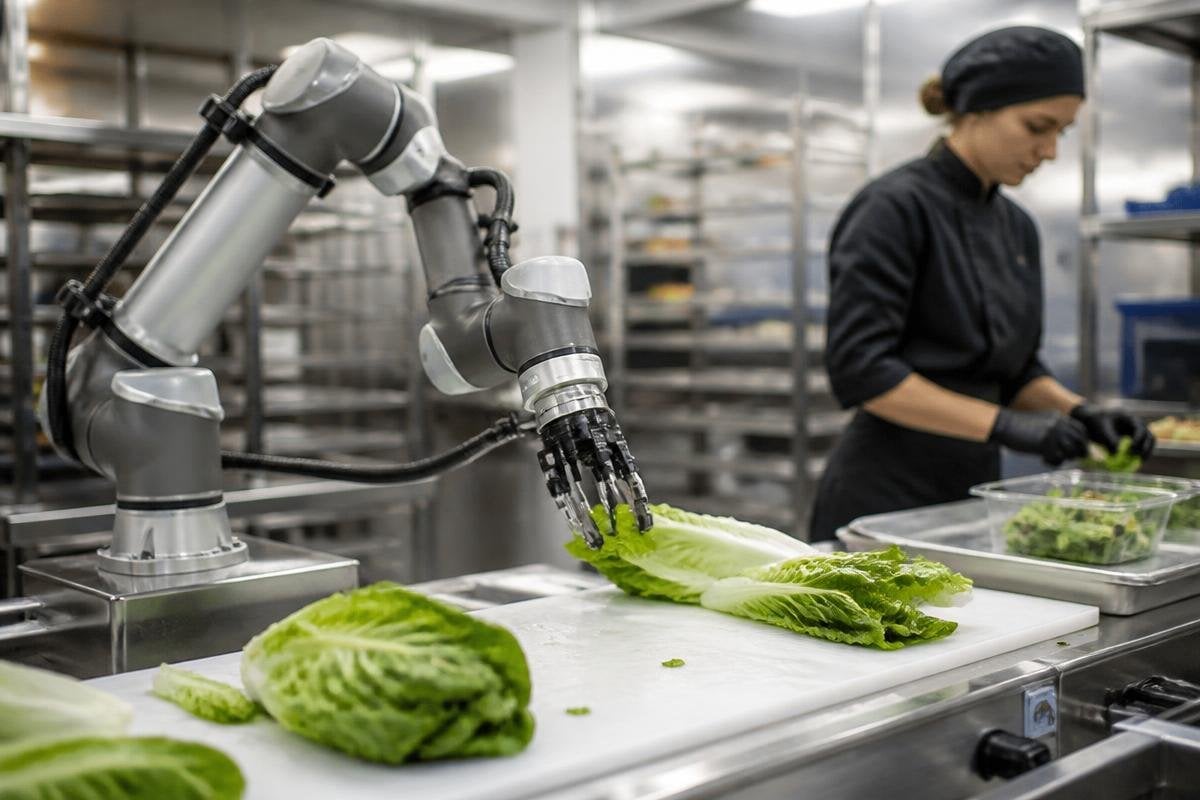
A food robot has to work around soft produce, changing shapes, spills, cold rooms, and people. That makes food automation harder than moving a fixed box from one shelf to another.
For anyone judging a food robot, the useful question is practical: can it repeat one paid task for a full shift, with clear results and safe limits?
Quick read
- Food robots fit tasks with fixed locations, steady timing, and clear pass-or-fail results.
- Fresh food creates problems for grippers, cameras, cleaning, and quality checks.
- A serious trial needs measured cycle time, payload, uptime, cleaning needs, and failure rates.
The jobs robots can handle first
Food production gives robots many possible jobs, yet each job has a different level of difficulty. Moving trays through a fixed station is easier to control than picking loose fruit from a mixed bin.
A robot that loads a known container starts with better information about size, position, and weight. That makes the work itself the first design choice.
A useful system may sort items, place food into containers, move ingredients between stations, or inspect products with cameras. The robot needs a narrow task with a clear result before a wider system can make sense.
The same rule applies in restaurants and catering. Repeated work with fixed tools and set positions gives the robot a better chance of steady operation. A changing menu, crowded workspace, and handoff between people add problems that a short demonstration may leave out.
Why food is hard for machines
A robot arm can follow the same path every time. Food rarely presents the same shape or surface twice. A ripe tomato may deform under pressure, while a dry item can slip from the same gripper setting.
Cameras also face limits. Reflections, shadows, steam, dust, and overlapping items can make a product hard to identify. The software must find the item, choose a safe grip, move it without damage, and place it in the right spot.
Cleaning adds another test. Any food robot needs a clear plan for washdown, trapped residue, tool changes, and inspection between runs. A machine that works well for an hour may still create extra labor if staff must take it apart after each production block.
The proof a buyer should ask for
A video can show that a robot completed a task. It can’t show how many attempts failed, how often a person had to intervene, or how much setup the task required. Those details decide the cost of running the system.
A food robot’s reported speed means little without the product, task, and conditions behind it. Robot 24 gives you named machines and company statements to place beside those details as you compare suppliers.
Ask the supplier to define the test before you compare results. The same robot may produce different figures with a different product mix, gripper, lighting setup, or operator nearby.
A useful trial record should include:
- Cycle time: record pickup and placement as separate timestamps, with the product and task named.
- Payload: include the item weight, container weight, and tool weight in the test.
- Uptime: record the run length, planned stops, faults, and human interventions.
- Quality: count dropped items, damaged food, missed items, and rejected placements.
- Cleaning: record the time, staff, tools, and parts needed between runs.
The open question is the cost of handling exceptions. A person can spot a crushed package, remove a blocked tray, or change a grip when an item behaves differently. A robot may need a pause, a remote operator, or a new program.
That support work belongs in the trial budget. So do integration, safety checks, training, spare parts, floor space, and changes to the production line. A low purchase price can lose its appeal if the robot needs a person beside it for every unusual item.
Food companies also need to decide how much variation the system must accept. A machine for one package size can be easier to run than one expected to handle an entire product range. The wider the range, the more testing the buyer needs before signing off on the system.
A practical buying check
Before a food robot moves from a demo area into production, check these points:
- Name one task and its pass-or-fail result.
- Run the robot with the real food, packaging, lighting, and workspace.
- Record failed picks and human help during a full planned run.
- Measure cleaning time with the staff who will do that work.
- Price integration, training, service, spare parts, and floor changes.
- Set a stop rule if quality or uptime falls below the agreed level.
Food automation will grow where the task stays steady enough for a machine and costly enough to justify the support around it. I’d wait for measured production trials before treating a food robot as ready for a wider job.
The next useful proof is a full-shift record that shows output, failures, cleaning time, and human intervention in the same report.